

A successful Mosaic Wall starts with the participation plan. The artwork matters, but so do the guest numbers, capture points, event timetable and the way people add their photographs.
Start with the message
Choose a main image with a clear purpose: a brand identity, a campaign visual, a company anniversary or a shared ambition. Strong shapes and a clear composition tend to read better from a distance. Review how the image looks at the finished wall size and when guests stand close enough to find their tile.
Match the grid to the audience
The number of tiles needs to make sense for the expected participation and the time available. A large board is not automatically a better experience. Agree the tile size, likely contribution rate and whether each guest session produces one or several tiles. Plan how the wall will look at different stages of the event.
Think about capture and guest flow
A branded booth or mirror gives guests a defined capture point. An upload route can help connect remote teams where the software and project scope support it. Position the capture station, print area and wall so people can understand the journey without blocking circulation.
For a London conference or exhibition, discuss installation access, loading windows, power, connectivity and queue space before the event plan is finalised. The same planning applies to venues in Hampshire, Surrey and the surrounding South East.
Plan the reveal and the handover
Decide whether the wall builds continuously, whether a reveal has a scheduled moment and what you want to keep afterwards. A physical mosaic, a digital file and a shared viewing experience are different deliverables. Include them explicitly in the brief.
Measure the right things
Useful measures can include participation, completed capture sessions and printed tiles. A photo shared by a guest is not the same as a verified impression or a conversion. Agree the reporting scope before the activation so the final review answers the questions your team actually has.
Learn from a delivered project
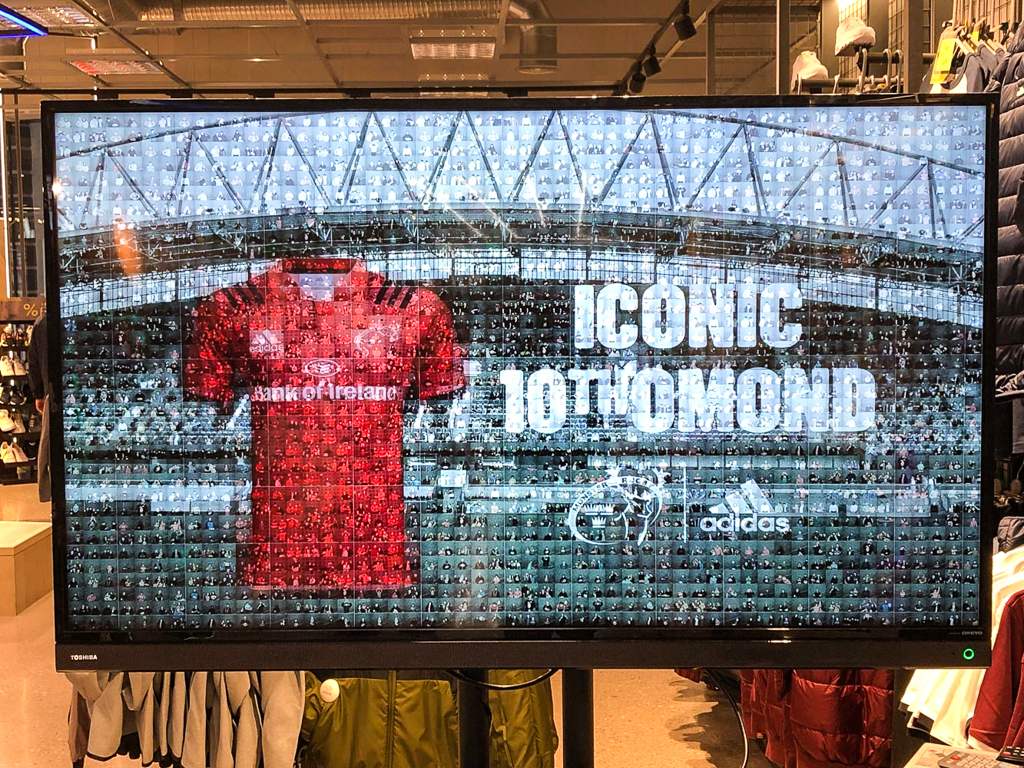
Our archived adidas and Munster Rugby tour ran over five weeks, with more than 2,000 images contributing to the final mosaic at Thomond Park. Inmarsat used a different approach: a 24-hour digital mosaic with an upload route for forty offices. The lesson is to design the workflow around the audience, rather than copy the same wall into every event.